
Fed holds rates steady in 9-3 vote as three regional presidents dissent in favor of a hike
Three regional presidents dissented in favor of a rate increase

Editorial team
Published Jul 29, 2026
Updated Wednesday, September 9, 2026 - 4:30 AMSep 9, 2026, 4:30 AM
The brief
What to know
- The Federal Reserve held its policy rate at 3.5% to 3.75% in a 9-3 vote.
- Three regional bank presidents dissented in favor of an increase.
- The split highlighted disagreement over the balance between inflation risk and economic slowing.
Why it matters
The decision affects borrowing and saving conditions, while the dissents provide information about how the committee may react to incoming data.
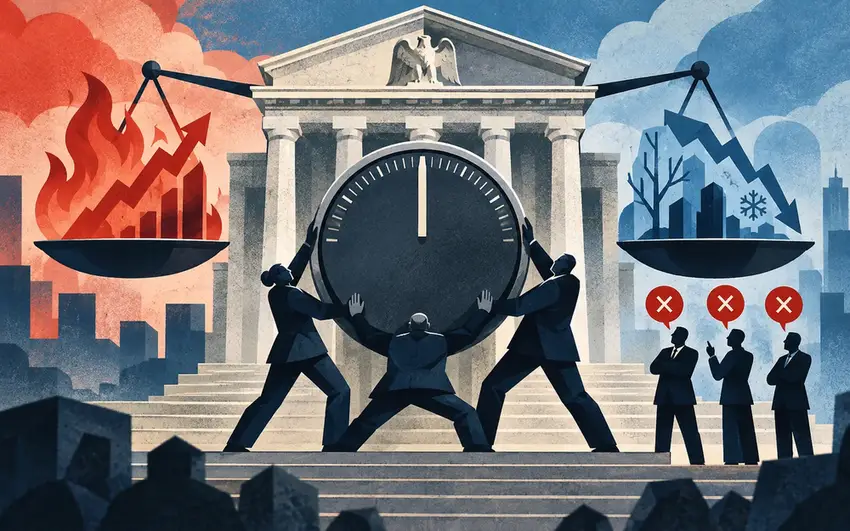
The Federal Reserve voted 9-3 to hold its benchmark interest rate steady at its July meeting, in a decision publicly marked by an unusually sharp internal disagreement, as three regional Federal Reserve Bank presidents dissented in favor of raising rates immediately.
A rare hawkish split
The Federal Open Market Committee kept the federal funds rate in a target range of 3.5% to 3.75%, extending a hold that has now lasted five consecutive meetings following three rate cuts in late 2025. Cleveland Fed President Beth Hammack, Minneapolis Fed President Neel Kashkari and Dallas Fed President Lorie Logan all dissented, each preferring a quarter-point increase; it was the first time since September 2016 that three policymakers dissented with a unified view of which direction rates should move, and analysts described the committee as containing a newly vocal bloc of hawks. No members of the Fed's Board of Governors joined the dissent.
The chairman's approach
The split presented an early test for Fed Chairman Kevin Warsh, who has pushed back against giving markets detailed forward guidance on the central bank's next move, arguing the committee needs to observe how markets react to developments "direct and unfiltered" rather than pre-committing to a path. "I want to stress, of course, that decisions by this committee matter a great deal, and where necessary and appropriate, we will not hesitate to act," Warsh told reporters after the meeting. President Trump, who has pushed for lower rates, said afterward that Warsh was "a brilliant guy" who would personally prefer lower rates but was constrained by what the president called a "political" board.
How markets reacted
Markets reacted sharply. The Dow Jones Industrial Average closed roughly 1,100 points lower on the day, its worst single-day performance in more than a year, while Treasury yields spiked: the 30-year Treasury yield jumped past 5.2%, its highest level since 2007, and the 10-year yield rose more than seven basis points to 4.677%. Mortgage rates, which tend to track longer-term Treasury yields, also drifted higher in the days that followed.
What the minutes later revealed
Minutes from the meeting, released three weeks later, showed the hawkish sentiment extended well beyond the three formal dissenters. The minutes quoted participants saying that "policy tightening would likely be necessary if inflation did not decline," with some officials adding that current financial conditions might not yet be restrictive enough to bring inflation back to the Fed's 2% target. Separately, Bloomberg reported that two non-voting regional presidents, Kansas City's Jeffrey Schmid and St. Louis's Alberto Musalem, indicated they too would have backed a rate increase had they held a vote in July. Since the meeting, incoming data has complicated the picture: nonfarm payrolls fell in July and core inflation readings came in softer than feared, pulling back market expectations for a rate hike at the Fed's next meeting in September.
Transparency
Sources & reading notes
This source-based article explains a dated market or household-finance development. It is general information, not individualized financial advice; rates, prices and reported totals change.
Spot something that needs attention? Review our corrections process.